


The Art of Being Available
We’ve all heard about the 3 As that make a great physician: availability, affability, and ability.
But what does it truly mean to be available?
For some physicians, it means handing out their personal cell phone and being available 24/7. Now, I don’t think being available necessitates that level of access (unless you’re in the business of building a concierge practice), but I certainly respect those who do, and have handed out a personal number on occasion with no ill effects.
What I do think being available means, however, is being present for our patients, both in terms of the time spent face-to-face in the clinic, and the turnaround time it takes to schedule them in the clinic.
After all, what’s one of the most common criticisms of doctors? I don’t have the data, but it sure seems like it’s not spending enough time with patients. And what’s the rebuttal from doctors? Probably something related to all the un-accounted for, un-reimbursed work that takes place outside of the exam room, both before and after the visit.
In fact, in 2005, it was estimated that doctors spent 14% of their time doing work related to a patient visit outside of the exam room, and 23% of their time doing work related to a patient not physically present for a visit at all.1 Those numbers are in all likelihood much higher in 2026. Wouldn’t it be a win-win if we could recapture that time? We would increase face-to-face time with patients by up to 37%! That sounds like it would translate to a lot more happier patients.
More face-to-face time with patients means happier patients and smaller inboxes.
But while “spending more time with patients = good” makes intuitive sense, few resources discuss how to do it. So, here’s how I aim to do it in 2026.
Being Available Outside of Clinic
First, a (potential) hot take: it is difficult to provide proper medical care over EHR messaging. You cannot evaluate the patient, and more so are relying on a patient’s self-interpretation of their status to guide care, which can be unreliable.
In my experience, EHR messaging only begets more EHR messaging.
The best practice is to bring patients in for a visit, establish a diagnosis, and set forth a definitive plan of care instead of kicking the metaphoral inbox can down the road.
With this in mind, the goal of being available outside of clinic is uniform: to get the patient to the clinic.
Now, in the age of digital medicine, I do think clinic can mean both office or video visits. But the aim is to see patients with acute problems on the same or next day. That way, patients are seen, concerns heard, and plans put in place. This not just optimizes patient care, but increases patient satisfaction by way of more face to face access. It also prevents the endless cycles of phone-tag that can occur when physician-patient phone schedules never seem to sync.
So, if a patient messages with an acute concern, offer a same day or next day visit.
What constitutes an acute visit? In my mind, it includes anything that is concerning to the patient. This can include:
- Questions, concerns, and clarifications
- Family questions and concerns
- Medication refills
- Prior authorizations
- Insurance paperwork
- Medical excuses
If you’re concerned enough to call, I’m concerned enough to recommend we schedule an appointment.
Keep in mind, in order to offer same day or next day visits, there must be some flexibility within one’s schedule. Keep a small amount of visits un-booked or at least un-overbooked to accommodate the urgent request that comes in.
Being Available Inside of Clinic
Once a patient is in clinic, it’s important to then demonstrate the time we spend on patient care.
This means performing as much of the visit in-person as possible.
That includes chart review, image interpretation, test ordering, and documentation. A short pre-visit review is encouraged, to re-familiarize oneself with the patient at hand, but don’t spend minutes and minutes looking at labs, images, etc. that could be better done in person.
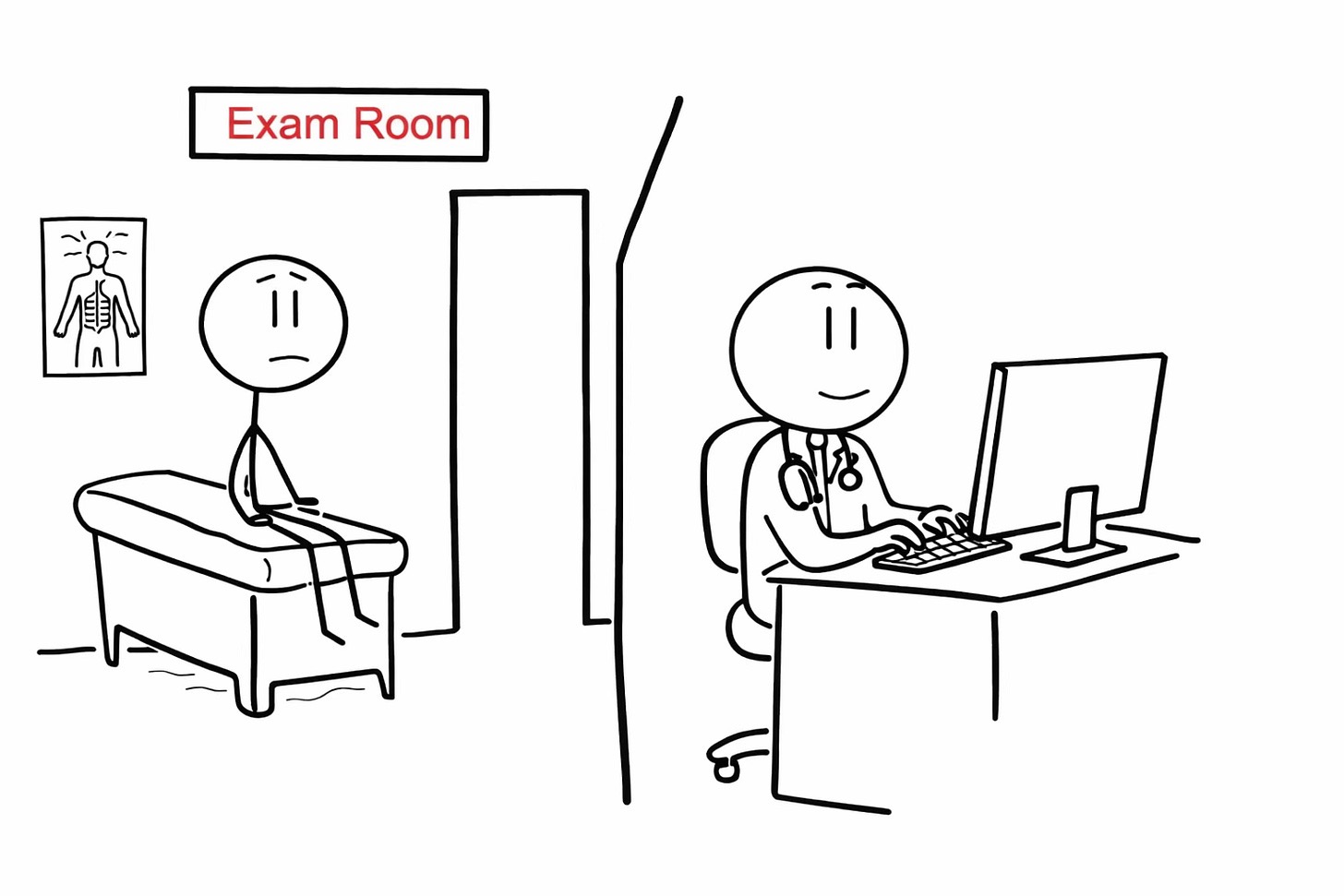
A graphical illustration of what not to do in clinic.
Here’s a sample workflow:
- Pre-chart prior to the visit (<5 min): this is not an extensive chart review. I structure my progress notes to try to capture all the relevant information related to a visit, so that I can read the last note and have a clear picture about the patient’s conditions and management to date. I then edit the information as needed to update it for the current visit.
- Review outside notes, labs, and images during the visit: During the visit, after establishing an initial or interval history, I then tell the patient it’s time to review their labs and imaging and invite them to join me. Avoid the temptation to review this outside of the examination room! I angle the computer screen towards them, and we review the data together. For images, I will pull the scans up and scroll through the slices together, pointing out the pathology.
- Write the note in the examination room: “So to summarize,” I say, turning to the patient, and then proceed to recap their examination while documenting in the A&P. It provides a nice cap to the visit, ensures the patient and physician are on the same page, and allows for clarification as needed. “Here’s what I’m writing,” I tell them, and if they have questions they can interject.
- Sign, print, and deliver: At the end of each visit, print the progress note and hand it to the patient. Reiterate important instructions, and underline specific points.
This could easily add an additional 5 minutes of patient time to a 15 minute visit, making for an increase of 33% more face-to-face time with the patient! Whether or not it translates to improve satisfaction scores remains to be seen, I’ll report back at the end of 2026.
1Gottschalk A, Flocke SA. Time spent in face-to-face patient care and work outside the examination room. Ann Fam Med. 2005 Nov-Dec;3(6):488-93. doi: 10.1370/afm.404. PMID: 16338911; PMCID: PMC1466945.