


An Introduction to Split/Shared Visits
A split/shared visit is an encounter in which both a physician and a non-physician practitioner (NPP) each perform a portion of the visit (on the same date of service, and with the same patient). The visit is thus “split” (or “shared”) between the physician and NPP, and billed under the practitioner who performed the more substantive portion of the encounter.
What counts as a split-shared visit?
A split/shared visit is an E&M encounter in which a physician and NPP (e.g., a nurse practitioner or physician assistant) each perform a portion of the work. That means, they each see the same patient on the same date of service and contribute meaningfully to the visit. You can only bill the visit once, and do so under the practitioner who performs the more substantive part of encounter, which means either the more time-intensive or cognition-intensive portion.
Here are some more basics:
- Shared services include both face-to-face and non face-to-face activities.
- Services billed under the physician are paid at a higher rates (100%) than the NPP (85%), which can influence institutional practices.
- Documentation must identify that two practitioners performed the service.
What counts as the substantive portion?
Just as with non-split/shared visits, split/shared visits can be billed either based on time or medical decision making (MDM).
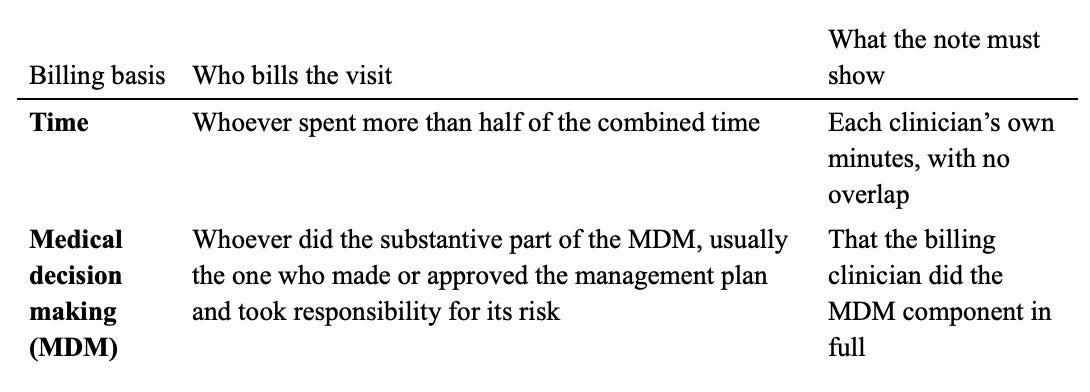
If the visit is billed based on time, the service is reported by the professional who spent the majority of the time during the encounter. Importantly, shared time cannot be counted twice. For example, if the physician and NPP spent 15 minutes discussing the case together, those 15 minutes must be assigned to either the physician or NPP, but not both.
If the visit is billed based on MDM, the service is reported by the professional who approved the management plan, and so assumes the responsibility for that plan with its inherent risk of complications. In most encounters, that’s the attending.
A few more notes about split/shared visits:
- Add modifier -FS. It identifies the visit as a split/shared encounter.
- Someone has to see the patient face-to-face. But it doesn’t have to be the person who did the substantive portion of the encounter.
- Data credit goes to the interpreter. For MDM, only the clinician who independently interprets a test can count it in the data element.
In many cases, best practice can be to have the NPP see the patient and write the note, and then have the physician add an addendum with their contributions.
Example: billing based on MDM
Let’s say a NPP sees a patient in the hospital who was admitted with elevated liver chemistries, a new pancreatic head mass, fevers and chills. He documents a progress note, which includes the chief complaint, history, physical examination, and portions of the assessment and plan, including:
Assessment:
- Elevated liver chemistries
- Sepsis, secondary to cholangitis
- Pancreatic head mass
Plan:
- Continue supportive care
- Trend liver chemistries
- Continue broad-spectrum antibiotics
- Plan for EUS and ERCP for tissue acquisition and stent placement
To complete the encounter, the physician would then add an attestation to the NPPs note, which contains the complete assessment and plan, along with a statement of responsibility similar to this:
“I, Dr. X, saw the patient with NPP. I made or approved the management plan for this patient encounter. I take full responsibility for the plan with its inherent risk of complications and/or morbidity and/or mortality of the management of this patient.”
Example: billing based on time
Now let’s bill that same encounter based on time. Let’s assume the NPP spent 15 minutes on the patient encounter. The physician spent 10 minutes reviewing the details of the case, and another 10 minutes discussing the case with the NPP. The physician could then add an attestation documenting 20 additional minutes of distinct time. The total time is 35 minutes, and the physician spent 20 of them (more than half). The visit is billed under the physician, based on 35 minutes, with modifier FS.